
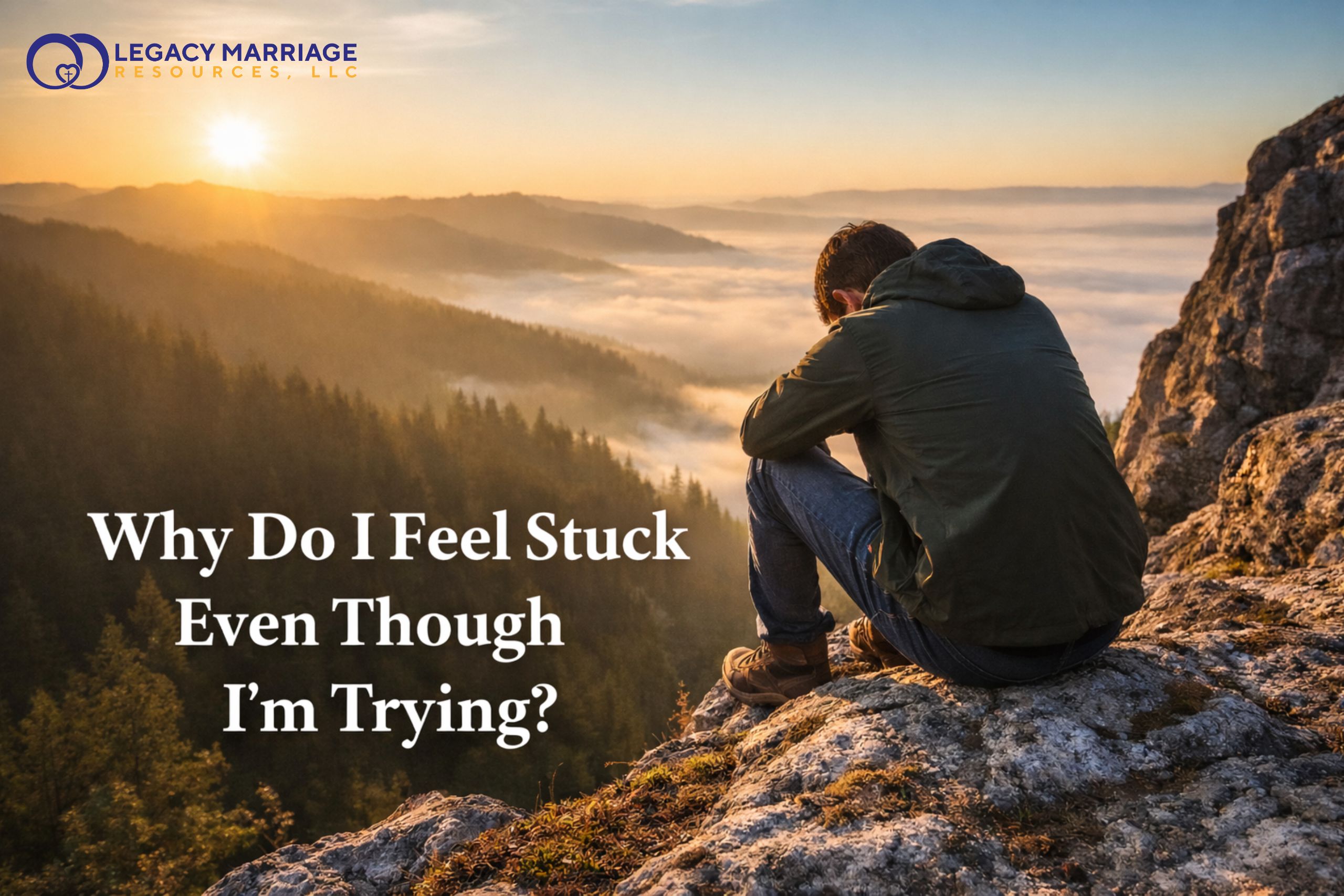
(Understanding emotional plateaus, patterns, and when support helps)
Sometimes I wake up and feel like I’m not making progress—no matter how much effort I’m putting in. I’m trying. I care. I’ve set goals. But it still feels like I can’t get traction.
I call that feeling stuck.
Maybe your mind feels foggy. Maybe you’re overloaded. Maybe you’re frustrated and tired of spending energy on goals that keep slipping out of reach. If that’s you, stay with me.
Because you’re not alone—and you’re not broken.
Most people hit seasons like this. It’s part of being human. And while it’s normal to feel stuck sometimes, you don’t have to stay stuck. In fact, feeling stuck doesn’t mean you’re failing. It often means something deeper needs attention.
And the good news is: once you understand what’s really happening beneath the surface, you can take practical steps forward.
What “Feeling Stuck” Actually Looks Like
Feeling stuck often shows up right when a new year is underway. You start strong, then life happens. Work gets intense. Kids need more. Someone gets sick. Stress piles up. Your schedule collapses. You drift back into old habits or patterns that feel familiar.
And it’s frustrating—because part of you genuinely wants to do better.
Sometimes stuck looks like:
- Starting strong, then losing momentum
- Repeating the same habit cycle (even after promising yourself you wouldn’t)
- Feeling numb, foggy, or emotionally flat
- Feeling like you’re “functioning,” but not thriving
Common thoughts when you feel stuck
- “I know what I should do… I just can’t seem to do it.”
- “Why do I keep ending up back here?”
- “I’m trying, but it doesn’t feel like anything is changing.”
- “I start strong and then I lose momentum.”
- “Maybe I’m just not disciplined enough.”
- “I feel tired all the time—even when I’m not doing that much.”
- “I don’t even know what I feel—I’m just numb.”
- “I’m overwhelmed, but I can’t explain why.”
- “I keep repeating the same pattern in my relationship.”
- “I keep telling myself: ‘This is the year…’ and then nothing changes.”
- “I’m functioning, but I’m not okay.”
- “I’m afraid I’ll try again and fail again.”
- “I don’t want to burden anyone, so I keep it to myself.”
- “I feel guilty for feeling this way—my life isn’t that bad.”
- “I don’t need therapy… but I also don’t know what else to do.”
If any of these hit home, it doesn’t mean you’re broken. It may mean you’re carrying more than you were meant to carry alone.
Why Effort Alone Doesn’t Always Create Change
If you’re stuck, one of the most frustrating things is realizing you’ve been trying hard… but it’s not working.
It’s like punching a wall, but the wall is too hard. Your knuckles are getting bloody and bruised, but you’re determined to get through the wall. So you try kicking it. After a while, you lose strength and end up on the floor exhausted, wondering, “Why can’t I break through?”
Sometimes it also feels like pushing a car that won’t move. You push harder, strain more, and end up exhausted thinking, “Why won’t this budge?”
Here’s why: effort is important, but effort alone isn’t always the solution.
A few things can be true at the same time:
- Willpower is limited. You only have so much emotional energy each day.
- You can’t out-discipline unprocessed pain. Hurt has weight, and it slows you down.
- You can’t problem-solve emotions you haven’t named. If you can’t identify what’s happening inside, you may not be working on the right thing.
- Trying harder without clarity often increases shame. And shame rarely produces lasting growth.
I’ve had couples ask me, “How much longer do we have to keep trying before things change?” That question carries so much exhaustion. And it’s real.
Sometimes your limit isn’t about weakness—it’s about overload, pain, and missing tools. That’s why the goal isn’t simply “try harder.” The goal is to get clearer.
5 Common Reasons People Feel Stuck (Even When They’re Trying)
If you want to get unstuck, awareness is your friend. Once you understand why you’re stuck, you can stop blaming yourself and start addressing the real barriers.
Here are five of the most common reasons.
1) You’re Carrying Unprocessed Stress, Grief, or Hurt
Unprocessed emotional weight creates drag.
Stress can make you irritable and reactive. Grief can make you tired and foggy. Pain can make you distracted and unable to focus. And if you don’t understand why you’re drained, it’s hard to do anything about it.
There’s a reason people say, “the body keeps score.” What you avoid emotionally doesn’t disappear—it accumulates. That’s why unprocessed stress can quietly stall your momentum.
2) You’re Stuck in a Pattern, Not a Problem
Many people think they’re stuck because of a problem… but they’re actually stuck because of a cycle.
Patterns are loops:
trigger → reaction → outcome → (new trigger)
You might be trying to solve the surface issue, but the pattern keeps feeding the issue. When you learn how the loop works, you can start changing what’s underneath it.
3) Your Nervous System Is Overloaded
When your nervous system is stuck in fight, flight, or freeze, it becomes hard to make consistent changes—even if you want to.
This is where people say:
“I know what to do… but I can’t get myself to do it.”
That’s not laziness. That’s often dysregulation. Your body is trying to protect you, but it’s also keeping you stuck.
4) You’re Trying to Change Without Support or Accountability
Another common reason people stay stuck is simple: they’re trying to do it alone.
People in recovery learn this fast—isolation makes change harder. And this applies to everyday life too. When you’re stuck, being alone with your thoughts tends to amplify the problem. You need another voice—someone who can help you reflect, stay grounded, and keep moving.
Here’s the phrase I use often:
Change is hard in isolation. When you combine support (community) with honest self-assessment (reflection), growth becomes more sustainable—and often faster.
A practical example:
- Reflection: “I scroll most at night when I feel overwhelmed or lonely.”
- Support: “I text my accountability partner at 9:30pm, and we do a 2-minute check-in.”
That’s what it looks like when insight becomes a plan.
5) You’re Living by Expectations Instead of Values
Expectations often sound like:
- “This should be easier.”
- “I should be farther by now.”
- “This shouldn’t take so long.”
And when those expectations aren’t met, disappointment drains your energy.
Values sound different:
- “I value growth.”
- “I value perseverance.”
- “I value integrity.”
- “I value love and connection.”
Values give direction and meaning. Expectations create pressure and shame.
If you want to get unstuck, consider shifting from “what I expected” to “what I value.”
The Hidden Cost of Staying Stuck
None of us want to be stuck. It costs too much.
Stuckness often leads to:
- emotional exhaustion
- strained relationships
- increased irritability or numbness
- avoidance or escapism (doom scrolling, shutting down, procrastinating)
- lower confidence and self-esteem
- spiritual discouragement
But I don’t share that to scare you.
I share it because stuckness is not a life sentence. It’s often a signal, not a verdict. You don’t have to stay there.
A Quick Self-Assessment: Where Might You Be Stuck?
Take a minute and ask: Where is the stuckness strongest right now?
Choose one “stuck zone” to focus on:
- Emotions (anxiety, sadness, numbness)
- Relationships (communication, conflict, trust)
- Habits (screens, avoidance, procrastination)
- Identity (confidence, purpose, calling)
- Faith (dryness, guilt, distance, confusion)
Now reflect:
- What part of this zone feels hardest right now?
- What have you tried so far?
- What helped even a little?
- What made it worse?
Write a few notes down. Clarity grows when you slow down long enough to notice.
What Actually Helps You Get Unstuck
Being stuck is frustrating—and it can lead to hopelessness. But there are practical ways to start building traction again. Try one of these this week.
1) Name the Pattern (Not Just the Problem)
Instead of obsessing over the problem, map the pattern:
- What was the trigger?
- What story did I tell myself?
- What did I feel?
- How did I react?
- What was the result?
Then ask:
- What is one small shift that could change the pattern by 5%?
Small shifts become new pathways over time.
2) Build Emotional Awareness (Simple Daily Practices)
Emotional awareness gives you leverage. The more aware you are, the more you can respond instead of react.
Try this practice 3 times a day (2 minutes each):
- Sit and plant your feet on the floor.
- Take a slow breath.
- Scan your body (tightness, heaviness, pressure, tension).
- Name the emotion (use an emotion wheel if needed).
- Write one sentence: “Right now I feel ___ because ___.”
Simple, but powerful.
3) Learn a New Skill (Not Just New Motivation)
Many people keep restarting because they’re relying on motivation instead of skills.
Here are four skills that create traction:
Boundaries
Boundaries are the healthy limits you set to protect what matters—your time, energy, values, and relationships—so you can show up with love and integrity instead of resentment or burnout.
Short version: A boundary is how you say “yes” to what matters and “no” to what harms.
Repair Attempts
Repair attempts are the small words or actions you use to de-escalate conflict and reconnect after tension—like taking responsibility, softening your tone, asking for a reset, or offering reassurance.
Short version: A repair attempt is a relationship “reset button” in the middle of stress.
Emotion Regulation Tools
Emotion regulation tools are practical strategies that help you notice, manage, and redirect strong emotions so they don’t take over your thoughts, reactions, or choices—especially in conflict or stress.
Short version: Tools that help your feelings become information, not instructions.
Communication Scripts
Communication scripts are simple, structured phrases that help you express feelings and needs clearly—without blaming, escalating, or shutting down—especially when emotions are high.
Short version: A script is a “safe sentence” you can use when you don’t know what to say.
4) Get Outside Perspective
Sometimes you’ve tried everything you know to try—and you still feel stuck. That’s often a sign you need outside perspective.
That could be:
- a trusted friend
- a mentor or pastor
- a support group
- a therapist
Therapy offers clarity and structure. A counselor can help you identify patterns, regulate emotions, build skills, and create a plan that fits you instead of generic advice.
When Therapy Makes the Biggest Difference
Therapy can feel intimidating—especially if you grew up believing counseling was only for “serious problems.”
But therapy isn’t a last resort. It’s a tool for clarity, change, and breakthrough.
Therapy often helps most when:
- You keep repeating cycles
- Emotions feel bigger than the situation
- Your relationship is stuck in the same argument
- You feel overwhelmed, numb, or shut down
- You’re motivated but can’t find traction
If that’s you, it doesn’t mean you’re weak. It means support may be the missing piece.
A Gentle Invitation
If you’re still stuck, you’re not alone. Most people have been there—more than once.
And if you’re unsure whether counseling is right for you, you don’t have to overthink it. Start with a simple conversation. Our team in Augusta, GA, is happy to answer questions, and we can help you decide whether individual counseling, couples counseling, or another support option fits best.
Investing in yourself is a gift you give your future—and your family. Clarity is rarely something people regret pursuing.
If you’re ready to take a step, we’re here when you are.
FAQs
Why do I feel stuck even when my life is going okay?
Because stuckness is often about patterns, overload, or unprocessed emotions—not just circumstances.
Is feeling stuck a sign of depression or anxiety?
It can be connected, but not always. Sometimes it’s stress, burnout, grief, or nervous system overload.
How do I stop repeating the same patterns in relationships?
Start by identifying the trigger → reaction → outcome loop, then practice one small new response consistently.
Can therapy help if I don’t have a “big” problem?
Yes. Many people come for clarity, growth, and skill-building—not crisis.
How long does it take to feel progress in therapy?
It depends on the person and the goals, but many people feel relief simply by gaining clarity and a plan early on.
What if I’m stuck and my spouse won’t get help?
You can still start. Individual counseling can help you change patterns you control—and that can influence the relationship more than you think.
